Search this website

Community Toolkit: Learn

Learn

This section of the toolkit includes background information and resources that address questions such as:

  • How does screen use affect child and youth health and well-being? 
  • What can governments do to help keep children and youth safe in online spaces?
  • How can I connect with others working on these issues?

Some of these materials can also be used as handouts or leave-behinds if you are giving presentations or meeting with decision-makers.

Facts and evidence

What we know about children and screens

Young child learning using computer with headphone 2026 03 26 05 10 57 utc

Preschoolers

More screen exposure and use (including background TV) during infancy is associated with lower language skills at 3 to 4 years of age1.

  • Mobile device exposure and use is associated with expressive speech delay in 18-month-old children2.
  • Excessive screen time in early childhood is associated with poor performance on developmental screening tests at 2 to 5 years old3
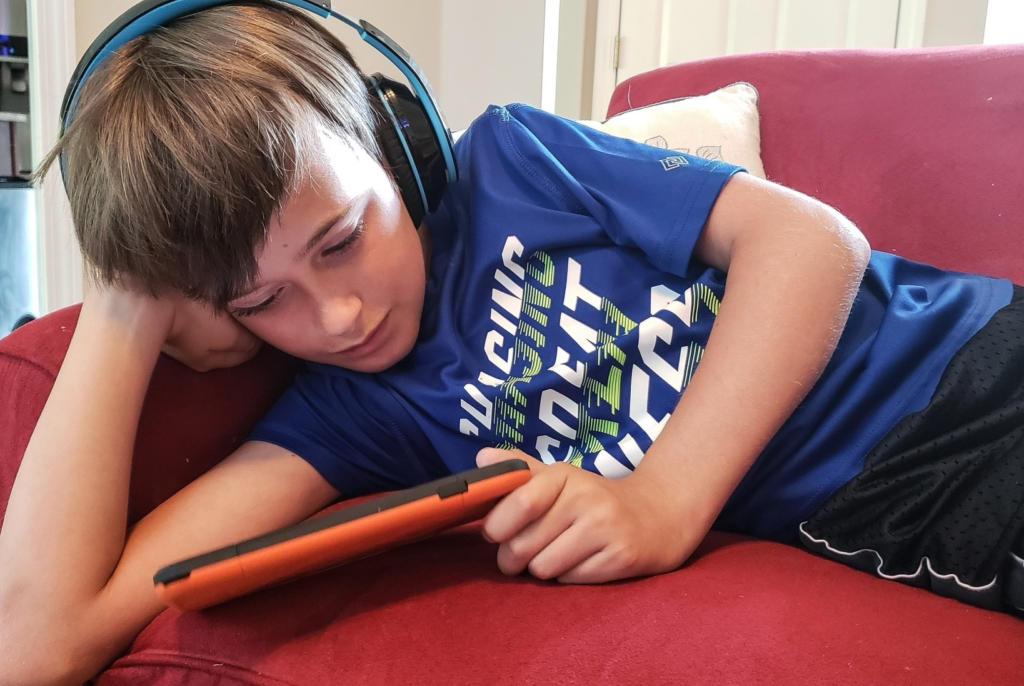
Boy with headphones lying on couch with tablet 2026 03 19 02 17 10 utc

School-aged children

  • Screen time and use in early childhood is associated with being less ready for school, with risk for poorer language and cognitive development in children 4 to 6 years old, especially among high users4
  • Higher total screen time (including TV and digital media) is associated with lower academic achievement levels in grade 3 reading and math and grade 6 math5
  • 86% of children aged 9 to 11 have an account on a platform that requires users to be age 13+6.
Two young adults sitting on sofa using phones 2026 03 25 10 48 45 utc

Adolescents

  •  Nearly a quarter of youth aged 16 and older in Canada spend 7+ hours per day on personal screen time, including social media7.
  • Two-thirds of youth regularly use digital devices during the hour before bedtime, and 80% keep their smartphone in their bedroom overnight8. An earlier survey suggests that kids aged 11-17 are the most sleep deprived, with 16% of respondents reporting they use social media for at least 5 hours per day9.
  • Time spent on screen is significantly associated with subsequent anxiety and depression symptoms in high school students, with increasing use over time predicting greater emotional distress 10,11
  • In adolescents, social media use is strongly associated with eating-related symptoms and self-esteem, with self-esteem significantly mediating both social media use and problematic eating-related behaviours12.

Issue Briefs

These documents describe specific problems and make recommendations for policy solutions.

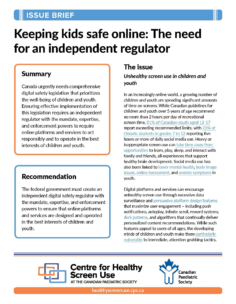
Canada needs comprehensive digital safety legislation to protect children and youth online. Effective implementation will require an independent regulator with the mandate, expertise, and enforcement powers to ensure compliance from online platforms and services. 

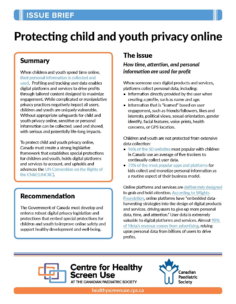
To protect child and youth privacy online, Canada must create a strong legislative framework that establishes special protections for young people, holds digital platforms and services to account, and upholds and advances the United Nations Convention on the Rights of the Child.

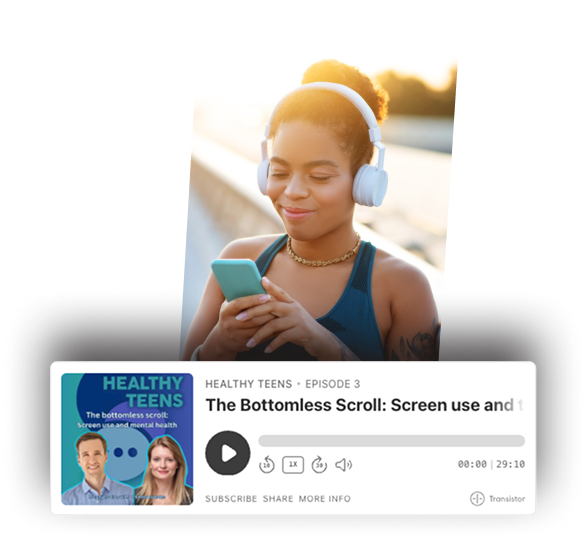
Healthy Teens Podcast

Healthy Teens is a collection of smart conversations on issues affecting youth health and well-being.

The show is hosted by adolescent medicine specialist Dr. Nicholas Chadi and is produced by the Canadian Paediatric Society. 

Learn Listen to the Healthy Teens Podcast now

More information

A number of organizations in Canada and internationally are working on specific aspects of digital health, from phones in schools to advertising/marketing to privacy. 

References

  1. Madigan S, McArthur BA, Anhorn C, Eirich R, Christakis DA. Associations between screen use and child language skills: A systematic review and meta-analysis. JAMA Pediatr 2020;174(7):665-75
  2. van den Heuvel M, Ma J, Borkhoff CM, et al; TARGet Kids! Collaboration. Mobile media device use is associated with expressive language delay in 18-month-old children. J Dev Behav Pediatr 2019;40(2):99-104. doi:10.1097/DBP.0000000000000630
  3. Madigan S, Browne D, Racine N, Mori C, Tough S. Association between screen time and children’s performance on a developmental screening test. JAMA Pediatr 2019;173(3):244-50. doi:10.1001/jamapediatrics.2018.5056
  4. Vanderloo LM, Janus M, Omand JA, et al. Children’s screen use and school readiness at 4-6 years: Prospective cohort study. BMC Public Health 2022;22(1):382. doi:10.1186/s12889-022-12629-8
  5. Li X, Keown-Stoneman CD, Omand JA, et al; TARGet Kids! Collaboration. Screen time and standardized academic achievement tests in elementary school. JAMA Netw Open 2025;8(10):e2537092. doi: 10.100/jamanetworkopen.2025.37092
  6. MediaSmarts. Life Online: Phase IV of Young Canadians in a Wireless World. 2022.
  7. Mental Health Research Canada. Associations between social media use, personal screen time, and mental health indicators among Canadian youth. April 2025: https://www.mhrc.ca/blog-research-brief/associations-between-social-media-use-personal-screen-time-and-mental-health-indicators-among-canadian-youth (Accessed February 25, 2026).
  8. MediaSmarts. New research reveals the online lives of youth during the pandemic. https://mediasmarts.ca/press-centre/press-releases/new-research-reveals-online-lives-youth-during-pandemic (Accessed May 13, 2026).
  9. Sampasa-Kanyinga H, Hamilton HA, Chaptut JP. Use of social media is associated with short sleep duration in a dose-response manner in students aged 11 to 20 years. Acta Paediatr 2018;107(4):694-70. doi: 10.1111/apa.14210
  10. Mourgharbel F, Chaput JP, Sampasa-Kanyinga H, et al. Longitudinal associations between different types of screen use and depression and anxiety symptoms in adolescents. Front Public Health 2023;11:1101594. doi: 10.3389/fpubh.2023.1101594
  11. Shannon H, Bush K, Villeneuve PJ, Hellemans KGC, Guimond S. Problematic social media use in adolescents and young adults: Systematic review and meta-analysis. JMIR Ment Health 2022;9(4);e33450. doi: 10.2196/33450
  12. Livet A, Boers E, Laroque F, Afzali MH, McVey G, Conrod PJ. Pathways from adolescent screen time to eating related symptoms: a multilevel longitudinal mediation analysis through self-esteem. Psychol Health 2024;39(9):1167-82. doi: 10.1080/08870446.2022.2141239